Traditional Japanese Architecture
Two thousand years of timber mastery, spiritual space, and the art of living in harmony with nature.
A Philosophy Built in Wood and Light
Traditional Japanese architecture is not merely a building technology — it is a complete philosophy of how human beings should inhabit the world. Unlike the stone fortresses of Europe or the brick palaces of China, Japan's builders chose timber as their primary medium, creating structures of extraordinary sophistication that respond to seismic forces, seasonal humidity, and the ever-present possibility of fire.
The result is an architecture of impermanence. Buildings were not built to outlast civilisations but to be repaired, dismantled, and reconstructed — sometimes every twenty years, as at Ise Jingu. This cyclical renewal is itself a statement of spiritual values: nothing is permanent; beauty lies in process and in the acceptance of change.
The key aesthetic principles that govern traditional Japanese buildings remain as influential today as they were a thousand years ago. They inform not only historic shrines and farmhouses, but the minimalist interiors of contemporary Tokyo apartments and the work of architects celebrated around the world.
-
間
Ma — Negative Space The conscious use of emptiness, silence, and pause as active architectural elements. Space defined not by what fills it but by what surrounds it.
-
侘
Wabi-Sabi — Imperfect Beauty The aesthetic of imperfection, impermanence, and incompleteness. A knotted beam, a moss-covered stone, the crack in a clay wall — each carries its own beauty.
-
間
Engawa — Threshold Space The veranda that mediates between inside and outside — a transitional zone where nature and dwelling interpenetrate, dissolving the hard boundary of wall.
-
序
Jo-ha-kyu — Sequential Progression The idea that arrival, approach, and entry should unfold in stages — a slow revelation that builds anticipation and transforms the experience of a space.
Himeji Castle
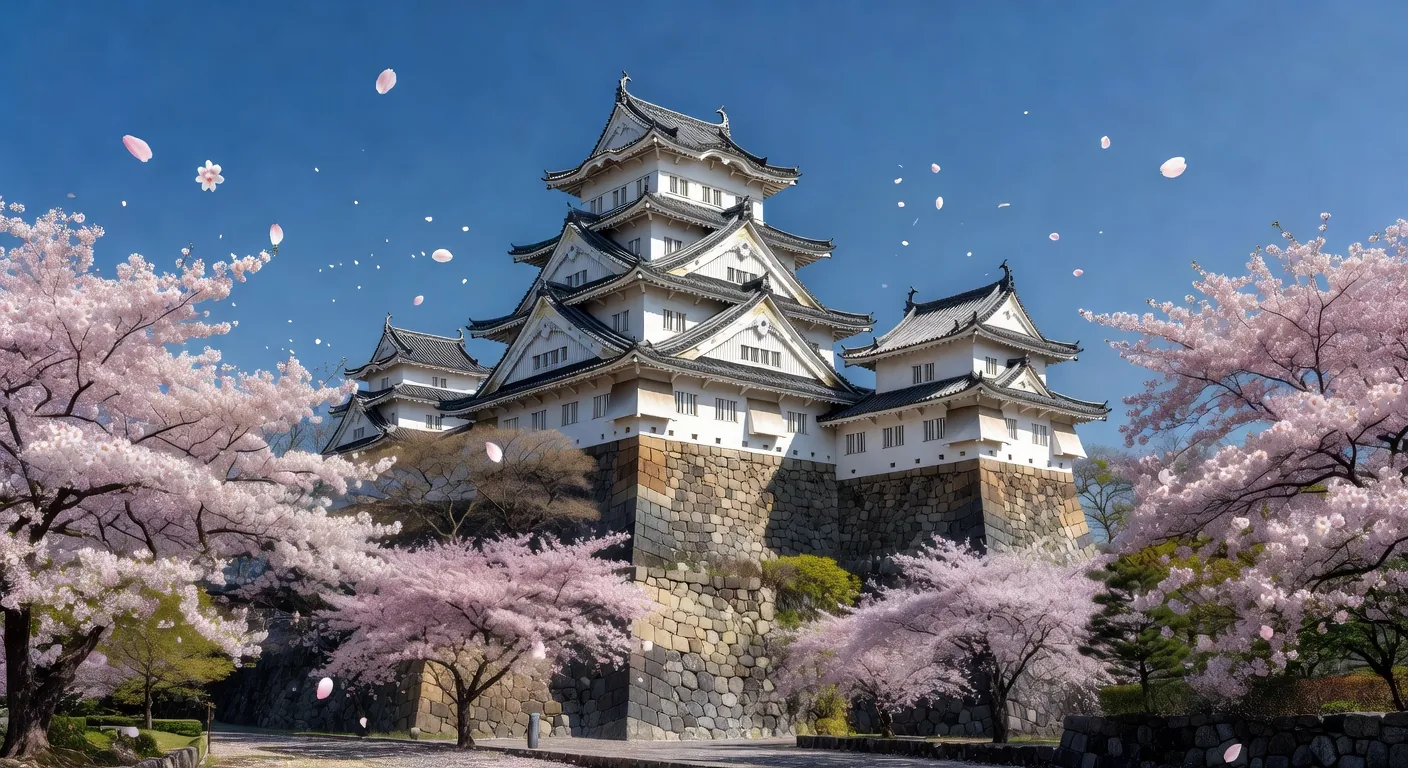
The White Heron Castle: Japan's Finest Surviving Fortress
Rising from the Harima Plain in Hyogo Prefecture, Himeji Castle — known as Hakuro-jo, the White Heron Castle — is widely regarded as the supreme surviving example of Japanese castle architecture. Its complex of 83 interlocking buildings, connected by winding stone-paved lanes, represents the full flowering of the military architecture of the Edo period.
The castle's whitewashed walls are not merely aesthetic. The lime plaster — layered up to a metre thick in places — served as fire-resistant armour, protecting the timber structure beneath from flaming arrows and the incendiary tactics of siege warfare. This tension between beauty and utility runs through every detail of the design.
The main keep stands seven storeys tall, though the internal floor plan — with its irregular stairways, deliberately disorienting passages, and strategically placed arrow slits — was designed to confuse and impede any attacker who breached the outer defences. Himeji was built to be impenetrable, and it was: the castle has never fallen in battle in over 400 years.
What makes Himeji transcendent is how it achieves military purpose through architectural grace. The soaring rooflines, the layered gables, the gentle curves of the white walls as they descend from the main keep — all conspire to produce something that reads not as a weapon but as a poem in stone and timber.
- Completed
- 1609 AD
- Height
- 46.4 metres
- UNESCO Status
- World Heritage, 1993
- Buildings
- 83 structures
Six Traditions of Building
Japanese traditional architecture encompasses a rich variety of building types, each shaped by distinct functional requirements, regional conditions, and philosophical traditions.
Minka Houses
民家
The vernacular farmhouses of rural Japan, built by regional craftsmen using local materials — thick thatched roofs, earthen floors, and massive exposed beams blackened by centuries of hearth smoke. Each region developed its own minka dialect: the steep gasshō-zukuri roofs of the Gokayama snow country differ entirely from the open-plan minka of subtropical Okinawa.
Shinto Shrines
神社
Shinto architecture at its purest is represented by Ise Jingu, rebuilt every twenty years in an act of ritual renewal that keeps ancient building techniques alive across generations. Shrine compounds are designed as a sequence of purification — torii gates, gravel forecourts, and the sacred forest as an architectural element — established to an inner sanctuary that is rarely entered and never displayed.
Buddhist Temples
寺院
Introduced from China via Korea in the 6th century, Buddhist temple architecture transformed Japanese building practice. The great halls of Todai-ji in Nara — still the world's largest wooden building — demonstrate the scale and ambition of this tradition. Temple gardens, kare-sansui dry landscape gardens, and the placement of buildings within natural topography are as carefully considered as the structures themselves.
Machiya Townhouses
町屋
The narrow, deep machiya of Kyoto, Kanazawa, and Takayama are the architecture of the merchant city — responding to street-front taxation with a minimal facade and a sequence of functional spaces stretching back through inner courtyards to a rear garden. Their slatted cedar facades and hanging noren curtains define the texture of Japan's historic urban streets.
Tea Houses
茶室
Sen no Rikyu's radical reformulation of the tea ceremony in the 16th century produced a new building type of deliberate rusticity and compression. The sukiya-style tea house — asymmetrical, imperfect, wabi in every detail — represents one of architecture's most complete expressions of a philosophical position. Its influence on modern minimalism is immeasurable.
Imperial Palaces
御所
The Katsura Imperial Villa in Kyoto (1615–1662) is widely regarded as one of the world's architectural masterworks — a stroll garden landscape in which pavilions, bridges, and teahouses create an endlessly shifting sequence of composed views. Its influence on 20th-century modernism, via Walter Gropius and Bruno Taut, shaped the global architectural imagination.
A Chronology of Japanese Architecture
Elevated Storehouses and Pit Dwellings
The earliest Japanese buildings were pit dwellings sunk into the earth for warmth, alongside raised-floor storehouses — the forerunners of shrine architecture — used to protect grain and sacred objects from flood and vermin. The structural principle of posts driven into the ground and rising to support a roof is the foundation of all subsequent Japanese building.
Buddhist Architecture Arrives from the Continent
The introduction of Buddhism to Japan in the 6th century transformed the built environment. Korean and Chinese craftsmen were invited to construct the first great temple complexes: Horyu-ji in Nara, completed around 607 CE, contains the oldest surviving wooden buildings in the world — pagodas and kondos whose structural system would define Japanese monumental architecture for the next millennium.
The Great Halls of Nara
Japan's first permanent capital at Nara was laid out on a Chinese grid plan, anchored by the Todai-ji complex housing the Great Buddha. The Daibutsuden — main hall of Todai-ji — was the largest wooden building ever constructed, its scale a direct expression of imperial ambition and Buddhist piety. The Shoso-in treasury, built on log-cabin principles, preserves the material culture of the period intact.
The Refinement of Aristocratic Space
The removal of the capital to Kyoto inaugurated four centuries of aristocratic cultural flowering. The shinden-zukuri palace style — a central hall connected by covered corridors to subsidiary wings surrounding a garden with a pond — created the prototype for the harmonious integration of architecture and landscape that remains central to the Japanese spatial ideal. The Phoenix Hall at Uji (1053) is its supreme surviving expression.
Zen Aesthetics and the Dry Garden
Zen Buddhism, which privileged direct experience over doctrinal learning, profoundly reshaped Japanese architectural aesthetics. The kare-sansui dry landscape garden — raked gravel and weathered stones representing sea and mountain — emerged as a meditative architecture in miniature. Simultaneously, the shoin-zukuri residential style formalised the spatial elements of the Japanese interior that persist to this day.
Castles, Gold, and Radical Simplicity
The age of unification under Oda Nobunaga and Toyotomi Hideyoshi produced the great castle towns and the tension between two opposing aesthetics: the extravagant gold-leaf decorated interiors of Momoyama palace architecture, and the deliberately austere wabi aesthetic of the tea ceremony as reformulated by Sen no Rikyu. Both traditions profoundly shaped what came after.
Urban Architecture and the Vernacular Tradition
Two and a half centuries of peace under the Tokugawa shogunate enabled Japan's urban architecture to reach extraordinary sophistication. The machiya townhouse tradition of Kyoto, the canal cities of Kanazawa, and the great post-town architecture of the Tokaido highway all emerged. Katsura Imperial Villa, begun in 1615, anticipates the spatial language of modernism with uncanny precision.
Tradition in Dialogue with the Modern World
The Meiji Restoration's embrace of Western technology forced Japanese architects into a complex negotiation between tradition and modernity that continues today. From Arata Endo's Arts and Crafts Japan to the Metabolism movement of the 1960s and on to the global practices of Tadao Ando and Kengo Kuma, contemporary Japanese architecture continues to draw deeply from its traditional roots even as it addresses the most urgent questions of the present.
In Japanese architecture there is a saying: ma is not empty space, but rather the pause — the silence that gives meaning to sound. A building without ma is noise. A building with ma is music.
Arata Isozaki Architect · Pritzker Prize Laureate 2019