Home Traditional Modern Landmarks Gallery Articles City Guides Trends Projects About

Knowledge & Research

Architecture Articles

Exploring the ideas, histories and philosophies that shape Japanese space

Showing 9 articles

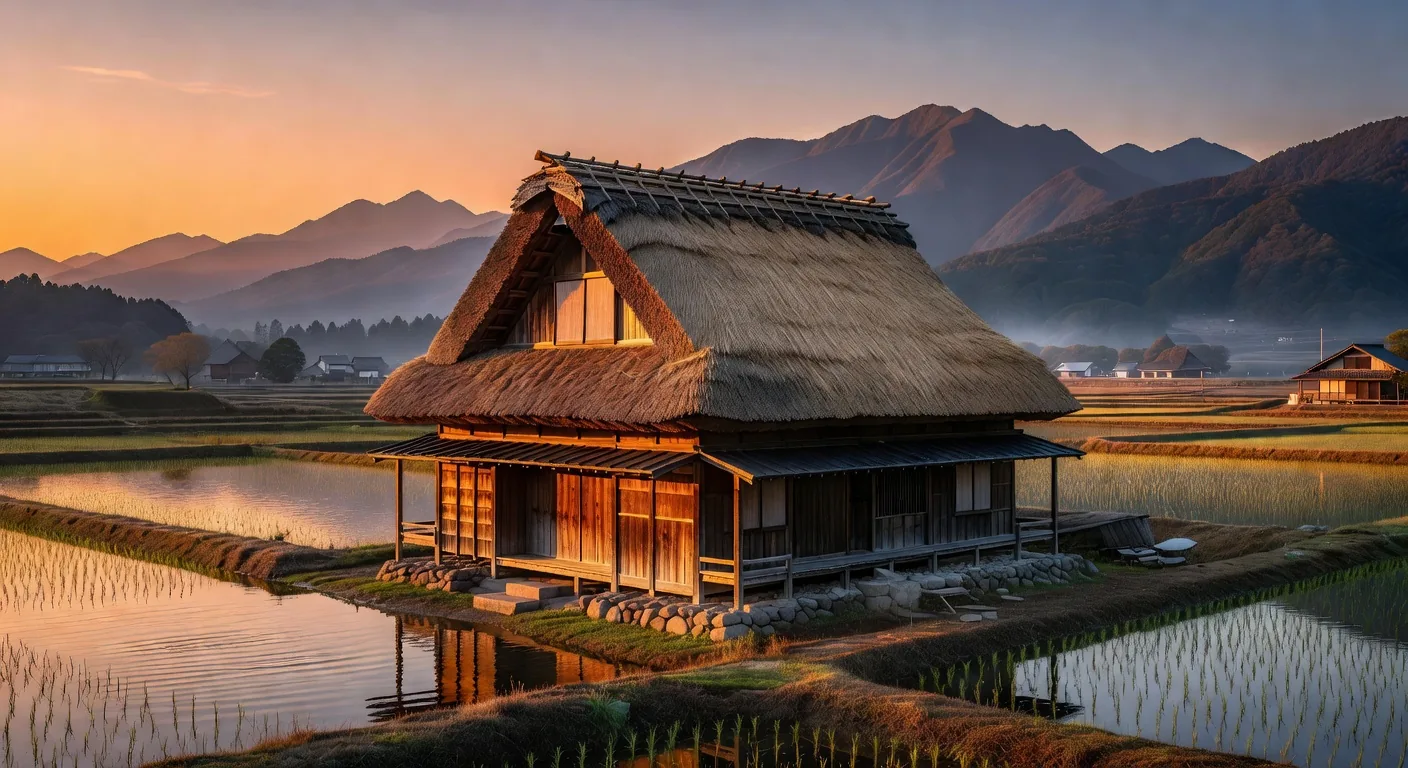
Featured Thatched farmhouse at sunset — Wabi-Sabi in Japanese Architecture

Philosophy & Aesthetics

The Philosophy of Wabi-Sabi in Japanese Architecture

In the West, beauty is often associated with permanence, symmetry and perfection. Japanese aesthetic philosophy offers a radical counter-proposal: that the deepest beauty is found in imperfection, in incompleteness, and in the quiet acknowledgment of time's passage. This is wabi-sabi — a compound of two historically distinct aesthetic concepts that, together, form one of the most influential philosophical frameworks in the history of built form.

Wabi originally described the melancholy and desolation of living alone in nature, the spare simplicity of a hermit's hut. Sabi referred to the patina of age — the rust bloom on iron, the moss creeping across stone, the weathered silver of unpainted timber. By the Muromachi period, tea masters such as Murata Juko and later Sen no Rikyu had synthesized these sensibilities into a single aesthetic that would govern the design of tea houses, gardens and ultimately much of Japan's vernacular architecture. The thatched farmhouses of Shirakawa-go, the worn stone lanterns of Kyoto's gardens, the unpainted cypress of Ise Jingu — all bear witness to an architecture that does not resist time, but participates in it.

Contemporary architects including Kengo Kuma and Terunobu Fujimori have returned explicitly to wabi-sabi principles as a counterweight to the globalizing tendency of late-modernism. For Kuma, the choice of materials — stone, wood, bamboo, paper — is not ornamental but philosophically necessary: materials must age honestly, must show their origin, must ultimately return to the earth.

All Articles — 9 entries

Philosophy

Ma: The Japanese Concept of Negative Space

Ma — the Japanese character for "space" or "gap" — describes an interval of emptiness that is not absence but presence. In architecture, ma manifests as the pause between shoji screens, the unbuilt courtyard at the centre of a residence, the silence that defines the form of a room.

Traditional

Tatami Rooms: Measurement, Design and Meaning

The tatami mat is simultaneously a unit of measure, a sensory surface and a social contract. Rooms across Japan were dimensioned by mat count — three-and-a-half, six, eight — and the arrangement of mats governed the subtle hierarchies of position and movement within the space.

Modern

Kengo Kuma's Material Explorations

Kengo Kuma has described his practice as "erasing architecture" — dissolving the hard boundary between building and landscape through the layering of natural materials. His use of cedar louvers, washi screens, stone screens and bamboo grilles creates buildings that breathe and shift with light.

Sustainability

Sustainable Lessons from Ancient Japanese Homes

Long before the language of sustainability entered architectural discourse, the traditional Japanese minka employed passive ventilation through raised floors and open eaves, seasonal screens to control solar gain, earthen walls with high thermal mass, and timber joinery assembled without metal fasteners for disassembly.

Gardens

The Evolution of the Japanese Garden

From the pond-and-island gardens of the Heian aristocracy to the compressed symbolism of the Zen rock garden, from the stroll gardens of the Edo daimyo estates to the contemporary conceptual gardens of the twenty-first century — Japanese garden design charts a remarkable evolution of ideas about nature, control and contemplation.

代謝

History

Post-War Metabolism: Japan's Radical Architecture

In 1960, a group of young Japanese architects and critics published a manifesto proposing cities as living organisms — structures that should grow, replace and renew their own cells. The Metabolist movement, led by Kisho Kurokawa, Kiyonori Kikutake and Fumihiko Maki, produced some of the twentieth century's most visionary architectural proposals.

縁側

Design

Engawa: The Transitional Space Between Inside and Outside

The engawa — a narrow wooden veranda running along the edge of a traditional Japanese house — is neither interior nor exterior but a disciplined threshold between the two. Sitting on the engawa, one is sheltered by the deep overhang of the eaves yet fully exposed to the garden view, the birdsong, the temperature of the season.

東京

Contemporary

Tokyo 2026: Architectural Transformations

Tokyo enters 2026 in the midst of its most significant urban transformation in decades. The Toranomon-Azabudai district has delivered a new skyline cluster; Shibuya's elevated garden district nears completion; and the ongoing Marunouchi redevelopment continues to challenge what a business quarter can mean for a city's cultural life.

Traditional

Sacred Geometry in Shinto Shrine Design

The approach to a Shinto shrine is an architecture of preparation. The sequence of torii gates, the gravel path, the temizuya purification basin, the haiden offering hall and finally the honden main sanctuary — each element is precisely positioned to calibrate the visitor's psychological and spiritual state before they arrive at the sacred core.

No articles match your search. Try different keywords.