About City Hostel Hub
"Bridging past and future through the art of Japanese space"
Bridging past and future through the art of Japanese space
City Hostel Hub was founded on the conviction that Japanese architecture — from the weathered timber of a mountain-village farmhouse to the luminous geometry of a contemporary art museum — represents one of humanity's most coherent and continuously evolving spatial traditions. Our work is to document it, interpret it, and make it accessible to the world.
Research
Original field investigation, archival study, and direct engagement with practitioners to produce authoritative documentation unavailable elsewhere.
Documentation
High-fidelity photography, measured drawings, and written records that preserve buildings and places for future generations of scholars and designers.
Education
Accessible long-form essays, city guides, and multimedia content that contextualizes Japanese architecture within broader cultural and historical narratives.
Preservation
Advocacy for heritage protection policies and support for the craftspeople and institutions working to maintain Japan's living architectural heritage.
The Japanese Design Principles That Guide Us
The editorial and research philosophy of City Hostel Hub is inseparable from the spatial philosophy we study. Japanese architecture — at its deepest — is not a collection of formal styles but a set of lived principles governing the relationship between human beings, the materials they use, and the natural world they inhabit.
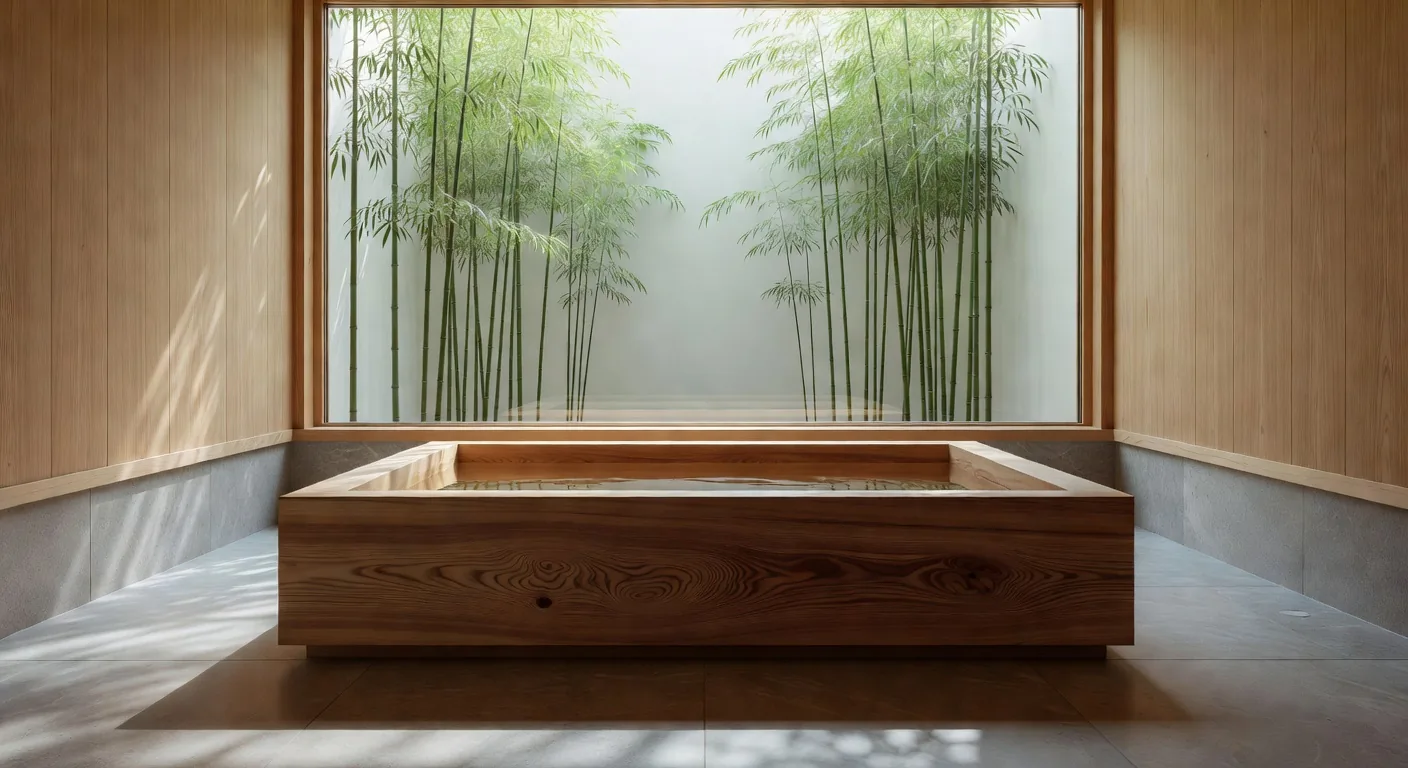
The bathroom above, hewn in Kiso hinoki cypress, distills this worldview: a single noble material, shaped with exacting craft, admits light, holds warmth, releases fragrance, and ages beautifully. Nothing is hidden. Nothing is superfluous. Every element is simultaneously functional and sacred.
These are the qualities City Hostel Hub seeks out and documents — not the spectacular or the trendy, but the enduring and the quietly profound.
-
一
Ma (間) — The Art of Interval Japanese space is as much about what is absent as what is present. Negative space, silence, and pause are treated as active elements of composition.
-
二
Wabi-Sabi — Beauty in Impermanence The Japanese aesthetic tradition honors the beauty of things that are irregular, incomplete, and weathered by time — a sensibility entirely at odds with the pursuit of perfection.
-
三
Shizen (自然) — Natural Order Buildings are not placed against nature but within it. Orientation, material selection, seasonal adaptation, and borrowed landscape are fundamental design considerations.
-
四
Mono no Aware — The Pathos of Things An awareness of transience pervades Japanese spatial design — from the deliberate impermanence of shoji screens to the seasonal replacement of tatami mats.
The People Behind City Hostel Hub
A small, dedicated team of researchers, writers, and visual artists united by a shared fascination with the built environment of Japan.
Hashimoto Yuki
Trained as an architectural historian at Waseda University, Yuki founded City Hostel Hub in 2018 after a decade of field research in rural Kyushu and the Kii Peninsula. Her writing on the vernacular architecture of Japan's mountain communities has appeared in international academic journals and design publications. She oversees all editorial direction and long-form research projects.
Nakamura Daichi
Daichi holds a Masters in Critical Theory from Tokyo University of the Arts and has written criticism for Jutakutokushu, Casa Brutus, and several European architecture publications. His focus is contemporary Japanese practice and the tension between global Modernism and indigenous spatial sensibility. He contributes regular critical essays and reviews of major exhibitions and completed buildings.
Saito Mizuki
Mizuki's architectural photography has been exhibited in Tokyo, Paris, and Chicago. She approaches buildings as sustained meditations rather than single-image studies, often returning to the same structure across multiple seasons and times of day to capture its full range of spatial qualities. Her work for City Hostel Hub has established a distinctive visual vocabulary that separates us from conventional architectural documentation.
Kobayashi Ren
Ren coordinates City Hostel Hub's research partnerships with Japanese universities, municipal archives, and institutional partners. With a background in urban geography from Osaka University, he specializes in documenting the intersection of infrastructure, policy, and built form in Japan's rapidly changing cities. He manages our relationships with the Architectural Institute of Japan and UNESCO Japan.
City Hostel Hub: A Timeline
From a personal research journal to Japan's most-referenced independent architecture platform — eight years of building something worth preserving.
Founded in Tokyo
City Hostel Hub launched as a personal research platform documenting vernacular architecture in rural Japan. Hashimoto Yuki's field notes from the Kii Peninsula formed the first body of published content. The initial site attracted 4,000 readers in its first month.
Editorial Expansion
Nakamura Daichi joined as Architecture Critic, bringing critical contemporary coverage alongside the historical research. City Hostel Hub published its first major long-form feature: a 15,000-word investigation of surviving Edo-period townhouses in Kanazawa.
Photography Partnership
Saito Mizuki's appointment as Photography Director transformed the platform's visual identity. The first photo essay — a full-season documentation of Kyoto's autumn light in machiya interiors — became one of the most widely shared pieces of Japanese architectural photography that year.
Institutional Recognition
City Hostel Hub was recognized by the Architectural Institute of Japan as a significant independent documentation resource. A formal research partnership with Tokyo University of the Arts followed, providing access to rare archival materials and supporting a new series on Meiji-era Western-influenced architecture.
City Guides Launch & 100k Readers
The launch of the City Guides series — in-depth spatial itineraries for Tokyo, Kyoto, Osaka, Hiroshima, and Nara — drove City Hostel Hub to 100,000 monthly readers for the first time. The guides were adopted by the Japan Tourism Agency as recommended resources for culturally engaged visitors.
UNESCO Japan Partnership
City Hostel Hub entered a formal documentation partnership with UNESCO Japan, contributing to the preparation of nomination materials for potential new World Heritage entries in the Tohoku and Chugoku regions. Kobayashi Ren joined full-time as Research Lead to manage this expanded scope.
Expanded Urban Projects Coverage
City Hostel Hub launches its Urban Development Projects section, tracking Japan's major regeneration and infrastructure investments in real time. Partnerships with Nikken Sekkei, Takenaka Corporation, and municipal development bureaus provide privileged access to project documentation currently in progress.
Institutional Collaborators
City Hostel Hub works in partnership with established academic, governmental, and cultural institutions committed to the documentation and preservation of Japan's architectural heritage.
Tokyo University of the Arts
Archival access & research collaboration
Japan Institute of Architects
Professional practice documentation
UNESCO Japan
World Heritage nomination support
Architectural Institute of Japan
Academic research partnership
Japan Tourism Agency
City Guides official recommendation
National Museum of Modern Art
Exhibition documentation & archive access
Contact City Hostel Hub
We welcome inquiries from fellow researchers, architects, photographers, and institutions. Whether you have a question about our work, a collaboration proposal, or simply want to share a building you think we should document — we'd love to hear from you.
Address
1-4-8 Marunouchi
Chiyoda City, Tokyo
Japan 〒178-0065
Response Time
We aim to reply within 2 business days